
We've all taken the ride on the NBN (National Broadband Network), haven't we? From the bright lights of promised high-speed broadband to the hard ground of a multi-technology mix in the real world, it's been something of an adventure. But where next?
As the digital landscape in Australia appears poised to transform, so too must the underlying infrastructure. In this blog post, we take an in-depth journey on the future of the NBN in Australia, looking at how our national network is evolving to meet the challenges of the digital transformation era.
We'll take a look at the ongoing upgrades, the rise of competitors like 5G, and what it all means for you, the regular Australian. Buckle up for the exciting internet future in our nation!
A Quick Summary
It’s an in-depth discussion on the Future of the NBN in Australia, seeking to provide clarity on the development of the network. It discusses ongoing upgrades on full-fibre technology, emphasizes the value of 5G as an alternative for high-speed broadbandconnectivity, and presents how the developments hold critical mass for the country’s vast digital transformation. The key takeaway is the transition of Australia into a faster, more reliable, and diverse broadband landscape, allowing for increased choice and capacity for homes and businesses.
The Next Chapter for the NBN: From Patchwork to Full-Fiber
You remember the early NBN rollout? It was an intricate tapestry of technologies, combining Fiber-to-the-Premises (FTTP), Fiber-to-the-Node (FTTN), Hybrid Fiber Coaxial (HFC), and several others.
Although this method provided a basic connection for millions, it inadvertently established a two-tiered system. While some reveled in the lightning-fast speeds afforded by FTTP, others found themselves reliant on a copper-based FTTN service that frequently faltered in delivering on its commitments.
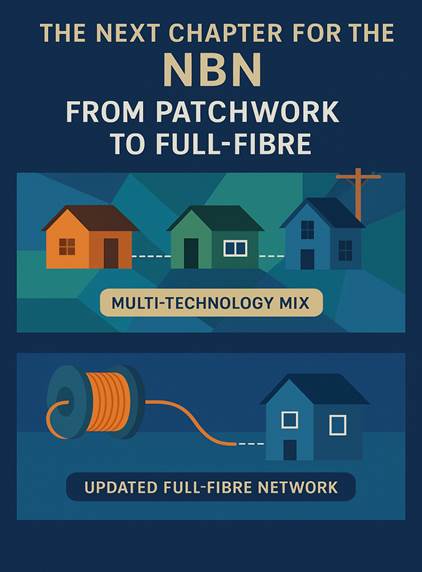
Fast forward to today, and the vision has undergone a remarkable transformation. NBN Co finds itself engaged in an extensive upgrade program to connect more homes and businesses directly to full-fiber. This development is not revolutionary.
By substituting the antiquated copper lines with cutting-edge fiber, the network's capacity and reliability will soar to new heights. The ultimate aim is to turn high-speed broadband into a reality for nearly all Australians.
Let’s discover why full-fiber is the gold standard!
Why the Holy Grail for Full-Fiber?
In everyday language, full-fiber is the best of the fixed-line internet. It's an end-to-end direct connection entirely of fiber optic cable, all the way from the exchange right down directly into the premises.
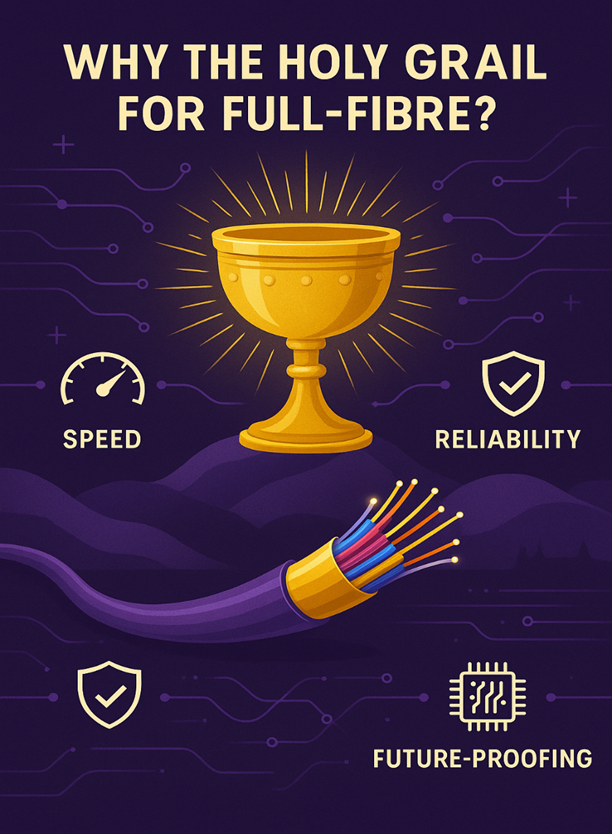
- Speed:
Fiber optic employs light for the transmission of data, so the speed greatly surpasses copper. Gigabit plans (1000 Mbps) and the emergence of multi-gigabit speed as the new norm.
- Reliability:
In contrast to copper, fiber is not prone to electrical interference or moisture. This results in fewer dropouts and a more stable connection, particularly during peak usage times.
- Future-Proofing:
The fiber connection has tremendous capacity that matches the needs of tomorrow's technology – from 8K streaming and cloud gaming to the Internet of Things (IoT) and smart home technologies.
The transition is more about going beyond facilitating quick downloads, but also about building the underlying infrastructure for a genuinely networked society. With this transition comes the next phase of digital transformation, as it energizes remote work, as well as online learning, along with telemedicine as well as smart cities.
5G: The Wireless Contender
Compared to high-speed broadband for decades past, the debate has long focused almost exclusively on the NBN. But now it has a new challenger: 5G. Promising wireless high-speed broadband at its best, 5G is fast becoming an attractive option for many Australians. It provides flexibility, is easy to set up, and for some users, it offers speed above their current NBN plans.
5G vs NBN: A Head-to-Head Comparison
Do you change NBN plans for 5G? It's not necessarily an easy decision. Let us outline the main differences so you can make the best choice.
Feature Table
| Feature | NBN (Fiber) | 5G Home Broadband |
| Speed | Highly reliable, with plans up to 1000 Mbps and beyond. | It can be very fast, with peak speeds comparable to NBN, but it can fluctuate. |
| Reliability | Consistent and stable. Not impacted by weather or line of sight. | It can be impacted by network congestion, distance from the tower, and obstructions. |
| Latency | Low and consistent, ideal for gaming and real-time applications. | Generally low, but can be less stable than fiber, leading to lag spikes. |
| Data | Unlimited data plans are standard and widely available. | Unlimited plans are common, but some may have speed caps after high usage. |
| Coverage | Near-universal across Australia, including regional/remote (satellite, FW). | Primarily in metro areas & large regional hubs, with ongoing expansion. |
The Contribution of Fixed Wireless and Satellite
It's also worth understanding that the NBN network isn't just fiber. For people in country and remote communities, Fixed Wireless, as well as the Sky Muster satellite service, have had a significant impact.
The NBN Co has also been upgrading these services, speeding them up as well as building capacity so as to serve these communities much better. It ensures the benefits of fast internet speed aren't just for urban areas but enable all people to link more electronically.
The Broader Impact: Powering Australia's Digital Transformation
The transition towards faster and more reliable internet is about more than just movie nights. It's an important component of the digital transformation of Australia. As a nation, we rely increasingly on online services on an everyday basis, and an independent internet connection enables this transformation.

What does it contain?
- Firms and Careers: The pandemic accelerated a large-scale shift to remote and flexible work modes. Good connectivity has now become crucial for companies to remain productive and competitive. Future technology will tend to go cloud-based and require seamless connectivity.
- Learning: It is now very usual for individuals to utilize online learning and distance education. University-level as well as primary school students need access to a quick, trustworthy internet connection so they can use learning materials.
- Health: Telehealth services have transformed health care, particularly in remote and country Australia. High-speed broadband allows high-definition video consultations, remote monitoring of patients, and the transmission of medical data safely.
- The economy: Experts in economics and policy say that having great broadband services is very important for a country’s success. A report by Accenture, asked for by NBN Co, showed that a faster and better NBN could increase Australia’s GDP by $400 billion by 2030. This is a big chance.
Expert Take:
“Telecommunication infrastructure the backbone of the fast-growing digital economy; the foundation for innovation in the age of smart cities and big data; and a key pillar of social equity and spatial justice.” — Tooran Alizadeh, Associate Professor, University of Sydney
FAQs: Demystifying Australia's Internet Future
1. What's in the Future of NBN Australia?
The Future of NBN Australia is largely fiber. It's dedicated to upgrading the millions of homes already served by slower FTTC and FTTN technologies to full-fiber. That will give them access to the fastest gigabit and multi-gigabit wholesale plans, so the network will have capacity for future data demands.
2. How do I check for an available NBN upgrade for my premises?
NBN Co also has on its website a dedicated address checker. It will allow you to see if your location qualifies for the upgrade or not. Your internet provider will also notify you when an upgrade becomes available. In order for you to get the free upgrade, you will need to choose an upgraded speed plan, as it is not automatic.
3. What is different about 5G home internet compared to the NBN in non-metropolitan areas?
The only alternatives for most who live in the bush in Australia have been the NBN's Fixed Wireless, along with the Sky Muster satellite options. While both of those continue to improve, 5G home internet adds another quick broadband option where it becomes available. But the NBN's Fixed Wireless network itself has also been greatly improved, now providing up to 100 Mbps speed, so it's an incredibly competitive choice.
4. When will the updates on the NBN conclude?
NBN Co has had an upgrade plan for several years. Those upgrades occur over time all around the nation, and millions of homes and businesses already have been upgraded or may receive an upgrade. The initial five-year Fiber Connect program will be substantially complete at the end of 2025, and it will run fiber all the way to about 90 per cent of the fixed line network.
The Road Forward: A Promising and Interconnected Future
The story of Australia's broadband is changing. It’s no longer about settling for less technology, but about aiming for top speeds and capacity. The Future of NBN Australia is more than just building new things; it's about giving power to people.
It’s about making sure every Australian has the tools to create, connect, and succeed in the worldwide digital economy. Whether you pick a strong fiber connection or a flexible wireless one, the growing competition and constant improvements mean that better times are ahead for Australian internet users.
Let’s welcome the journey and prepare for a brighter, more connected future!
