
It’s the question almost everyone’s asking – particularly with bills soaring faster than paychecks – “Will energy costs increase or drop in the next 5 years?”
For Australians, the response holds greater weight than ever. No matter if you’ve switched to solar panels or you’re a renter facing the pinch of soaring costs, understanding future energy prices Australia isn’t just useful – it’s your game-changing strategy for staying ahead.
In today’s guideline, we break everything down. Electricity forecast 2030: shifting power cost trends, environmental regulations, and global supply chains all redefine the outlook. But don’t worry! We’re breaking it down simply and keeping it relevant to Australia.
Let’s get started!
A Quick Summary
Intrigued about the future energy prices Australia may face? This guideline shares government policies, genuine insights, and market trends to reveal where electricity costs are likely to go. Also, you will learn how factors such as renewable energy, demand, inflation, and infrastructure will shape the electricity forecast 2030. Here's a quick takeaway – energy costs are likely to be volatile, but the long-term power cost projections suggest a gradual decline as renewables expand and grid efficiency improves.

What’s Driving Future Energy Prices Australia?
As the power sector of Australia evolves, a wide range of forces are shaping how – and what we pay – for electricity. Led by ambitious environmental goals and evolving global supply chains, a number of key factors are redefining where energy prices in Australia are likely to trend.
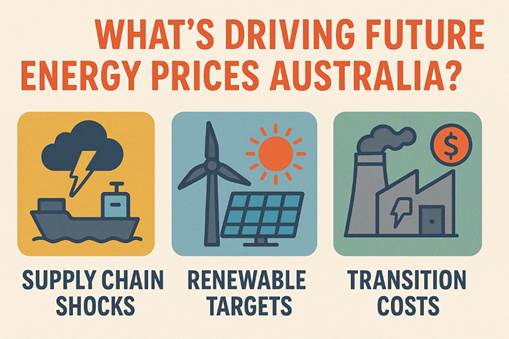
Let’s now quickly break down some of the core reasons behind the increasing (and falling) costs –
- Renewable Energy Targets and Transition Costs
Australia is shifting fast toward net-zero objectives. However, that sustainability push carries a price. The shift isn’t only about replacing coal with solar – it’s a multifaceted overhaul of storage, generation, and distribution systems. These infrastructure improvements are crucial but high-cost, and the burden will often be transferred to customers in the near future.
There are some regions that are also dealing with grid readiness; that means new renewable projects should be aligned with infrastructure rollouts to keep instability at bay.
- Government targets reaching up to 82% clean energy by 2030.
- Phasing out coal plants increases reliance on renewables and storage.
- Upfront spending on solar farms, batteries, and transmission lines is substantial.
Quick Stat – As per the AEMO (Australian Energy Market Operator), renewables made up around 40% of grid power in 2024, and projections indicate approximately 70% by 2030.
Expert Take – “The energy transition might raise prices short-term, but it will lead to more reliability and reduced costs in the long run.” – Dr. Alan Finkel, former Chief Scientist of Australia.
- Supply Chain Disruptions & Global Price Volatility
Even as the nation develops a grid powered by clean energy, it continues to be exposed to external pressures that can actually disrupt supply chains as well as drive-up costs.
Factors like fuel imports, foreign policy decisions, and commodity markets influence how much Australians spend on electricity – directly or indirectly.
- Conflicts (such as the Russia–Ukraine war) impact gas prices across the globe.
- LNG exports can divert domestic supply, driving up local expenses.
- Material shortages (such as lithium for batteries) can significantly delay infrastructure.
| Global Event | Impact on Australia |
| LNG export demand | Domestic gas price spikes |
| Geopolitical instability | Volatile import/export markets |
| Supply chain bottlenecks | Delays in renewable rollouts |
Key Insight: Australia’s future energy prices are tightly connected to global gas and oil market fluctuations, although the country is shifting to renewables.
- Demand Pressures & Electrification Surge
More households. More electric vehicles! And more power is needed.
- The population is expected to reach 30 million by 2030.
- EV adoption is gaining rapid momentum (estimated to account for 50% of car sales by 2029).
- Electrification of heating, cooking, and cooling intensifies demand.
All of this put added pressure on the grid – unless infrastructure improvements are fast-tracked.
So, what lies ahead? Expect a bit of a price hike especially during peak demand seasons, particularly in winter and summer, unless smart grid systems scale fast.
Electricity Forecast 2030 – What Are the Expectations?
Trying to understand where electricity prices are heading? You’re not alone! As 2030 approaches, an in-depth analysis by energy regulators provides insight into potential price trends – led by clean energy adoption, swiftly changing demand patterns, and infrastructure upgrades. Here’s what the numbers and industry outlooks reveal.
- AEMO’s Updated Energy Outlook
The 2024 AEMO ISP (Integrated System Plan) paints a cautiously optimistic image –
- Wholesale electricity cost will soar through 2026, then take a dip from 2027 to 2030.
- Households may witness short-term increases but long-term consistency.
- Grid-scale battery developments will help stabilize supply and decrease blackouts.
| Year | Projected Average Price (AUD/MWh) |
| 2025 | $112 |
| 2026 | $118 |
| 2027 | $101 |
| 2028 | $94 |
| 2030 | $87 |
Note – These reflect wholesale prices. Consumer rates may differ depending on tariff type, provider, and region.
- Retail vs. Wholesale – What’s the Key Difference?
You might wonder, “If wholesale prices fall, why are my bills still rising?”
That’s a fair question—and one that trips up many Aussie households. While wholesale prices grab headlines, they’re only one part of your final electricity bill.
Here’s the catch –
- Wholesale prices = What providers spend for electricity generation.
- Retail prices = Your final bill (includes network fees, retail margins, and taxes).
Retail costs are also influenced by –
- Distribution upgrades
- Retail competition
- Time-of-use tariffs
- Government concessions and rebates
So, don’t assume a direct correlation between declining wholesale rates and your bill.
Power Cost Trends to Watch Over the Next 5 Years
Australia’s electricity pricing is no longer driven solely by demand and supply. It’s now impacted by how we consume energy, the way we use it, and how the system structures its charges. As the energy market continues to evolve, expect to witness dynamic pricing models, changing incentives, and more cutting-edge infrastructure step into the picture.
Here are the key power cost trends, which could influence your energy bills by 2030.
- Tariff Restructuring & Demand-Centric Pricing
Expect more energy retailers to embrace dynamic tariffs –
- ToU (Time-of-use) plans: Higher rates at the evening peak hours
- Demand charges: Based on your highest usage spike in a billing period
- Subscription-style models: Fixed monthly pricing aligned with projected consumption.
Why it matters: If you can move usage to off-peak hours, you’ll save more.
- Renewable Saturation = Stability (Over Time)
Yes, the upfront expenses of renewables are exorbitant. However, once operational, solar and wind are among the most affordable energy sources per MWh.
The trend?
- Short-term: Prices may climb as coal exits and new capacity catches up
- Mid-term: Price balancing as storage and clean energy reach scale
- Long-term: Gradual reduction in production costs and grid reliance
- Policy Mechanisms and Regulation Reforms
State and federal governments are actively redefining the market.
Policies influencing future energy prices Australia include the following –
- NEM (National Electricity Market) reform
- Capacity Investment Scheme to encourage renewable projects
- WA’s Synergy Battery Deployment Program
- VIC’s Solar Homes and incentives for rooftop PV
“Government regulation will play a growing role power in pricing – being aware of policy is now an integral part of managing your bills.”
FAQs – What Consumers Should Know
1.Will my power bill keep soaring each year?
Not necessarily. While the next couple of years might bring a bit of a hike, costs could stabilize or decline by 2027 – 2030, especially with greater competition and renewables. Government-backed programs and infrastructure developments are also expected to reduce long-term costs. However, short-term uncertainty may persist due to fuel inflows, global supply shifts, and regulatory changes.
2. Are renewable energy sources more affordable?
Yes, of course, in generation cost per MWh. But the transition infrastructure (transmission lines, batteries, etc.) adds short-term expenses. In the long run, it’s a win! As storage technology rapidly improves and large-scale production takes effect, overall system expenses are expected to decrease further.
3. Can I manage my power costs?
Absolutely. Here’s how –
- Review the energy providers regularly (count on platforms such as EnergyMadeEasy.gov.au)
- Set up smart meters to keep a close tab and shift usage
- Check if you qualify for rebates and concessions
- Consider rooftop solar or a battery system
4. Should I switch to a variable or fixed plan?
That depends. In case you expect increasing prices, a fixed-rate energy plan may protect you. However, if prices fall, a flexible plan allows you to take advantage. Use our comparison blogs to decide.
5. Why are electricity costs different between states?
Pricing differs due to state-level regulations, the combination of power sources (coal vs renewables), infrastructure expenses, and regional market dynamics. For example, the electricity forecast for 2030 might differ in NSW vs. VIC, based on regional rules as well as grid developments.
Bottom Line – What’s the Verdict?
Australia’s energy market is undergoing changes. That means some unpredictability in the near future, but possible savings over time – if you make wise choices.
Let’s quickly recap –
- Short-term (2025–2026): Costs likely to rise slightly
- Medium-term (2027–2028): Market steadying with better infrastructure
- Long-term (2030): Reduced, more predictable energy rates (if policies stay on track)
So, if you’re wondering, “Will power costs rise or drop in the next 5 years?” – the response is – both, based on the timeframe.
- Stay informed
- Compare plans regularly
- Embrace smart usage habits
