
Fiber optic broadband is transforming how Australians connect, stream, work from home, study, and game. With technological upgrades and changes in Broadband Plans, the promise of faster downloads and uploads is no longer a luxury—it’s becoming standard.
In this blog, you’ll learn how connection type, optic speed, and smart plan selection matter. We'll simplify it all for you and explain what you get, why it's beneficial, how you can upgrade, and when the majority of the changes took place (or will take place).
This blog explains the benefits of Fibre Optic Broadband in Australia—covering connection types, optic speeds, and broadband plan upgrades—so you can make informed decisions about your internet options.

What is Fiber Optic Broadband?
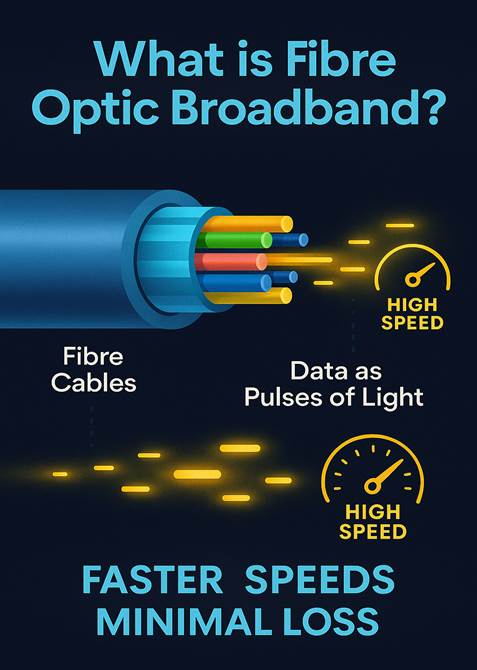
Fiber optic broadband is internet access through fiber cables that transmit data as pulses of light. Cables like these can transmit enormous amounts of data with minimal loss, offering much faster speeds than aged copper or wireless technology.
Connection Types in Australia
Australia's fixed-line network offers a number of connection types with different performance, prices, and potential for future upgrades:
| Connection Type | Brief Description | Common Speed Ranges* | Pros & Cons |
| FTTP (Fiber to the Premises) | Fiber cable directly to your house/business | Extremely high; up to 1-2 Gbps (or higher) downstream, high upload speed | Optimal performance; more future-proof. Higher installation cost and may require physical access. |
| HFC (Hybrid Fiber Coaxial) | Fiber to a node, then coaxial cable to premises | Capable of delivering Broadband Plans up to approaching gigabit speeds downstream | Good downstream performance, slow uploads. Upgrade potential is improving. |
| FTTN / FTTB / FTTC (Node / Building / Curb) | Part fiber, part existing copper infrastructure | More limited upload; variable maximum downstream dependent on copper distance & quality | Less cost, uses existing infrastructure; more prone to degradation of signal and slower upload. |
Speed ranges are dependent on infrastructure, plan, and hardware.
Perks of Fiber Optic Broadband
Shifting to fiber or better fiber-supported connections offers some actual benefits:
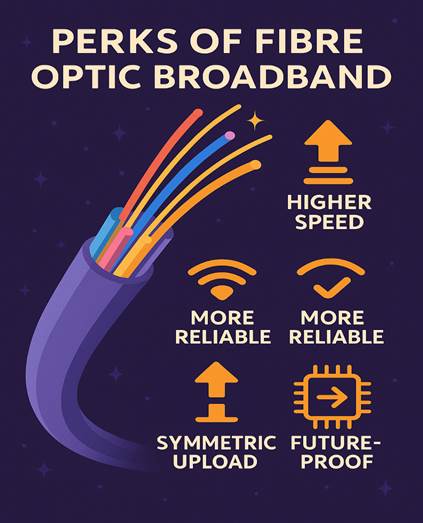
- Much Higher Optic Speed:
Fiber connections offer you speed levels much greater than old copper or wireless connections. Recent improvements entitle most Australians to experience Home Fast (500/50 Mbps), Home Superfast (750/50 Mbps), or even Ultrafast and Hyperfast speeds up to 2,000 Mbps downstream.
Note: 2 Gbps Hyperfast plans are available only from select providers and in specific areas on FTTP connections.
- More Reliability & Constancy:
During busy periods (typically 7-11pm), the majority of fixed-line internet retailers experienced 100-105% (or higher) of the planned advertised downstream speed. That's especially true with fiber links.
- Symmetric or Enhanced Upload Speeds:
Fiber to the premises (FTTP) and higher HFC have significantly greater upload, essential for video calling, uploading large files, remote working, and cloud backups. Wholesale upgrades more recently have boosted upload limits (e.g., for Ultrafast doubling upload from 50 Mbps to 100 Mbps).
- Future-Proofing Your Connection:
Data usage is projected to increase, with NBN Co estimating average monthly downloads could rise from ~460 GB in June 2024 to ~508 GB in June 2025, though this remains an industry trend projection.
- Improved Value in New Broadband Plans
Newer broadband plans are providing much higher speeds at the same cost. For example, speed tiers like NBN 100/20 are being upgraded to 500/50 over FTTP or HFC with no or very little extra wholesale cost to providers. This offers excellent value for a High-Speed Fiber connection.
Recent Upgrades and Statistics in Australia
What Changes Have Happened?
By late 2025, NBN Co is expected to complete several wholesale speed upgrades:
- Home Fast was raised from 100/20 Mbps to 500/50 Mbps.
- Home Superfast was raised to 750/50 Mbps.
- Ultrafast plans saw upload speeds upgrade to ~100 Mbps.
Approximately 9 million premises will be able to order the highest residential speed levels on fixed-line FTTP and HFC technologies as these upgrades roll out.
Usage & Adoption Data
Approximately 32% of Australians are on NBN 100 or faster, on a National Broadband Network 100 plan or above, up from 24% in the previous year.
The highest speed tier remains National Broadband Network 50 at ~42.5% of Australians.
Average monthly usage across premises grew over 10% from 460 GB to 508 GB in a year.
How to Choose or Upgrade Your Broadband Plan?
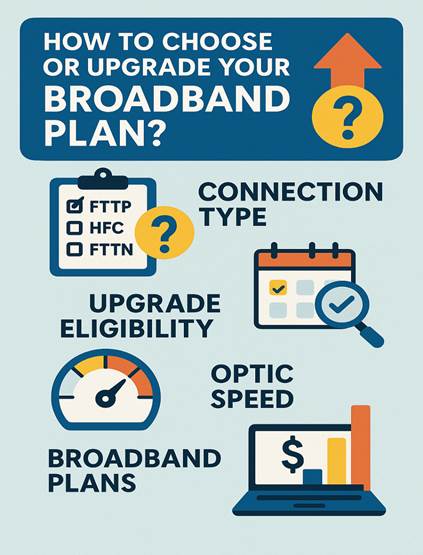
Questions to Ask:
- What kind of Connection Type do I have now (FTTP, HFC, FTTN, etc.)? Can it be upgraded?
- Check upgrade eligibility (e.g., free FTTP upgrades) that depends on the NBN Fibre Connect program’s availability in your specific area.
- What Optic Speed do I need based on usage: streaming, gaming, uploading, and number of devices?
- What do the current Broadband Plans cost for different levels of speed?
Plan Comparison: What You Can Get
Below is a sample of plan speeds vs. approx. prices:
| Plan Tier | Typical Download/Upload Speeds | What It's Good For |
| NBN 50 | ≈ 50/20 Mbps | Light streaming, small families, casual web browsing |
| NBN 100 to 500 | ≈ 100-500 down / 20-50 up | Several HD/4K streams, work from home, online learning |
| NBN 750 / Ultrafast | ≈ 750 / 50-100 Mbps | Multiple households, high uploads, gaming, cloud usage |
| NBN 2000 / Hyperfast | ≈ 2 Gbps | Very high demand setups; concurrent users/devices and high bandwidth use |
Note: Prices vary by provider and location; below are typical speed tiers and their ideal use cases.
Upgrading Tips
- Check your address on the NBN Co website or with your ISP to see if FTTP or HFC with higher degrees of upgrade are feasible.
- Hardware considerations: newer routers (Wi-Fi 6 or 7), internal cabling can help.
- If you’re on an older connection type (like FTTN), look into whether free or low-cost fiber upgrades are offered.
- Re-evaluate your plan when wholesale upgrades take effect—many people will get faster speeds for a similar cost.
Top Fiber Optic Broadband FAQs for Australians
1.What is the difference between fiber and other broadband types?
Fiber (FTTP especially) uses light signals over glass or plastic fibers. It's highly efficient. The others (copper, coaxial, fixed wireless) degrade with distance and reduced upload speed or increased latency. Fiber offers more consistency and speed.
2. Why are upload speeds lower on some fiber broadband plans?
Even on fiber networks, if you’re on FTTC, FTTN, or HFC with older hardware, upload capacity may be limited. In the past, the emphasis on uploads was less prominent. Recent Broadband Plans and Optic Speed upgrades are addressing that (e.g., Ultrafast tiers boosting uploads to ~100 Mbps).
3. When will most Australians be able to access the fastest fiber-based services?
More than 10 million premises (≈ 90% of the fixed-line network) will be eligible to order National Broadband Network Home Ultrafast products by the end of December 2025.
In a Nutshell
In a nutshell, fiber optic broadband gives Australians much better optic speed—download and upload; more reliable and consistent performance because of upgraded connection types (especially FTTP / better HFC); better value in new broadband plans, especially with NBN wholesale upgrades; and future-proofing for increasing digital needs.
If you're considering an internet package, it's worth investigating your Connection Type, usage, and whether it's possible to move to a fiber-enabled or higher-level service. The network is evolving, and there are many positives already available. Don't miss out on the benefits of fast internet.
