
In Australia’s digital-first world, choosing the right internet connectivity isn’t only about chasing the quickest speed but is also about what suits your budget, location, or lifestyle. And, in 2025, the decision for most of the Australians boils down to fixed wireless vs. fibre.
Whether you own a house, stay on rent, or run a budding business, picking a suitable high bandwidth network plan could feel a tad overwhelming. Still uncertain if you should opt for high-speed fibre, wireless broadband, fixed wireless, or even legacy options such as Fibre-to-the-Node?
This guide breaks down everything, explained in simple words so that you can make a wise choice that really works for you!
A Quick Summary
Come check out this guide, that compares fixed wireless vs fibre to help you choose the best broadband for your unique needs in 2025. Brace yourself to glean insights into how wireless broadband and Fibre-to-the-Node fluctuate in coverage, reliability, cost, and speed. At the end, you will explore the pros and cons of each option so that you can confidently choose an internet solution to fit your business or lifestyle.
Exploring Fixed Wireless vs Fibre: What’s the True Difference?
Before you go ahead and dive into any new plan or provider, let’s first demystify the debate around fixed wireless vs fibre. Both these options come up with high-speed broadband, but their technology as well as real-world outcomes are completely different.
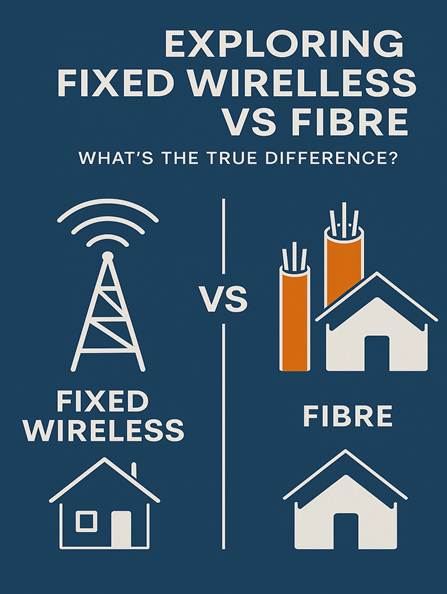
- Explaining the Fixed Wireless Broadband
Fixed wireless broadband utilizes radio signals to bridge your premises to the closest transmission tower.
- There is no need for underground cables to your door
- It’s a perfection option for both rural and regional locations
- Typically, a lot faster to install when compared to fibre
Advantages:
- An effortless and quick setup
- Ideal for hard-to-wire properties
- A reliable option for moderate usage
Disadvantages:
- Performance might lag especially in poor weather
- Limited by the overall distance to tower
- Typically, lower maximum speeds than fibre
So, the fixed wireless could be an amazing solution, but how does it affect or compare to fibre? Let’s quickly break this down.
- Fibre Broadband and Fibre-to-the-Node
Fibre broadband is considered the ultimate gold standard for agility and reliability, utilizing fibre-optic cables all the way to your house or close to it. There are some variants that include Fibre-to-the-Node (FTTN), where the final stretch might still run on copper.
Different Kinds of fibre broadband:
- FTTP (Fibre to the Premises): Pure fibre, possibly the fastest option
- FTTN (Fibre to the Node): Fibre to a local node, then copper to your home
- FTTC (Fibre to the Curb): Fibre to the curb, then a short copper stretch
Advantages:
- Consistently quick speeds (often 100Mbps or even higher)
- Low latency, which is perfect for streaming, gaming, and video calls
- Future-forwarded for the emerging technology upgrades
Disadvantages:
- Installation might take a slightly longer bit of time
- Limited availability in certain remote areas
- Higher pricing for full-fibre plans
Now that you are already acquainted with the basics, let’s now find out how these options compare across multiple factors that matter most to Australians.
Fixed Wireless vs Fibre: A Comparison Table on Features
Here’s a quick side-by-side glance at the core features to help make a better decision – fast!
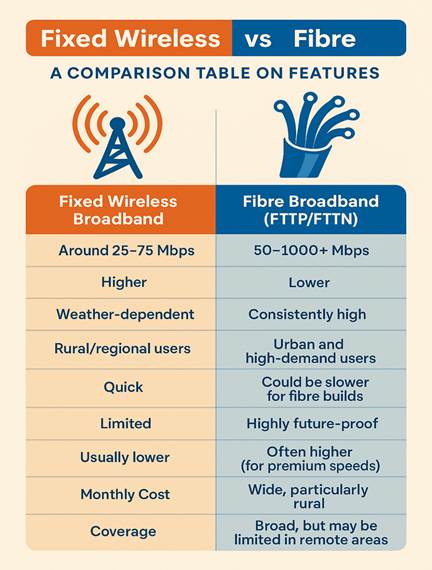
| Feature | Fixed Wireless Broadband | Fibre Broadband (FTTP/FTTN) |
| Typical Download Speeds | Around 25–75 Mbps | 50–1000+ Mbps (FTTP); 25–100 Mbps (FTTN) |
| Latency | Higher | Lower |
| Reliability | Weather-dependent | Consistently high |
| Best For | Rural/regional users | Urban and high-demand users |
| Setup Time | Quick | Could be slower for fibre builds |
| Upgrade Potential | Limited | Highly future-proof |
| Monthly Cost | Usually lower | Often higher (for premium speeds) |
| Coverage | Wide, particularly rural | Broad, but may be limited in remote areas |
Are you still uncertain? Let’s now answer some real-world queries that every Australian asks each day while comparing fixed wireless vs fibre.
How Do You Pick the Perfect Internet Connection for Your Needs?
Let’s now quickly work through the “When, How, What, and How” of picking your next internet connectivity with answers to the commonest questions.
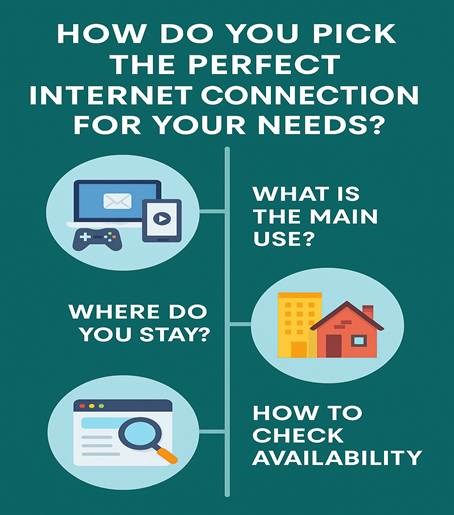
What is the Main Use for Your Broadband?
- Light use: Need a suitable option for sending email, browsing, or basic streaming? Fixed wireless is usually fine!
- Heavy usage: 4K streaming, video calls, remote work or online gaming? Fibre broadband (particularly FTTP) is recommended.
- Small business: Fibre makes sure of consistency for cloud apps, online sales, or VoIP.
Next, take into account where you live, as the importance of location is paramount in this decision.
Where Do You Stay? Urban vs Regional Choices
- Urban areas: Fibre is often available and worth the investment.
- Regional/remote: Wireless broadband might be your most suitable high-speed option!
Expert Take: “Across a number of regional towns, the fixed wireless comes up with solid speeds. However, if you are into a fibre area, you will witness more optimum long-term value from a fibre plan.” – NBN Co. spokesperson, 2026
How to Check What’s Actually Available at Your Address
- Pay a visit to the official NBN address checker
- Enter all your details to see if fibre, Fibre-to-the-Node, or wireless broadband is provided
- Compare different plans on reliable websites such as Canstar Blue or WhistleOut
Let’s now quickly clear up some crucial questions so that you can choose between fixed wireless vs fibre – with confidence.
FAQs: Fixed Wireless vs Fibre in Australia
- Is Fibre Better Than Fixed Wireless?
Fibre is considered a superior option for consistency, speed, and future-proofing. However, in areas with zero fibre rollout, fixed wireless is the only way to get blazing-fast high‑bandwidth network.
2: What About the Fibre-to-the-Node?
Fibre-to-the-Node (FTTN) comes up with fibre to a local node, then copper to homes. It is always a better option than all-copper but not as speedy or trustworthy as FTTP. For thousands, it’s nothing but a mid-range option between full fibre and wireless.
3: What’s the Core Difference Between Mobile Broadband and Fixed Wireless?
Fixed wireless relies on a local tower and fully dedicated receiver at your residence. Mobile high‑bandwidth networksrun on the 4G/5G mobile network, useful for portable hotspots, but a bit less stable for always-on home usage!
4: When Should I Level Up from Fixed Wireless to Fibre?
- Your residence needs faster speeds (think about smart TVs, multiple users, or WFH scenario).
- You want a bit lower latency for video calls or gaming.
- National Broadband Network or your provider provides a full fibre upgrade in your region.
Final Tips: Making the Best Choice
Here’s a quick checklist to guide you in the followings –
- Thoroughly check your address: See whether you can get fibre, Fibre-to-the-Node, or fixed wireless
- Assess your requirements: How many devices, what kind of activities, or any future upgrades planned?
- Compare different plans: Consider looking at data caps, speed tiers, and price points
- Always look ahead: If fibre is widely available, it’s the more future-forward option
Always remember, picking between fixed wireless vs fibre is all about striking a balance between reliability, cost, speed, and availability. For the most optimum long-term results, always choose the fastest and most stable connectivity you can reasonably afford – your digital future is dependent on it!
