
In a country as incredibly vast as Australia, it could be a challenge to find a fast and reliable internet, especially for those based outside major cities. Satellite Internet Australia has become the most trusted choice for businesses and people in outlying areas, delivering digital access where cables simply don’t extend.
With new Satellite Plans promising better flexibility and speeds, and increasing demand for strong rural coverage, more Australians are questioning whether satellite is the smartest choice among today’s NBN Alternatives.
A Quick Summary
Satellite Internet Australia has become an essential choice for remote regions, delivering crucial connectivity where traditional networks don’t work. In this blog, we break down the major advantages and drawbacks of satellite access, helping Australians weigh it against other NBN alternatives and broadband options. Also, get set to discover how satellite plans work, where rural coverage excels, and the regions where performance may lag so that you can decide for your business or house.
The Rise of Satellite Internet Australia: What’s Fueling the Shift
In a vast country like Australia, remote landscapes can make fixed internet truly difficult to access. Satellite Internet Australia has literally become a go-to choice for farmers, residents, and businesses located off the grid. The big ask - does it really stack up as the smartest choice for you? Let’s find out!
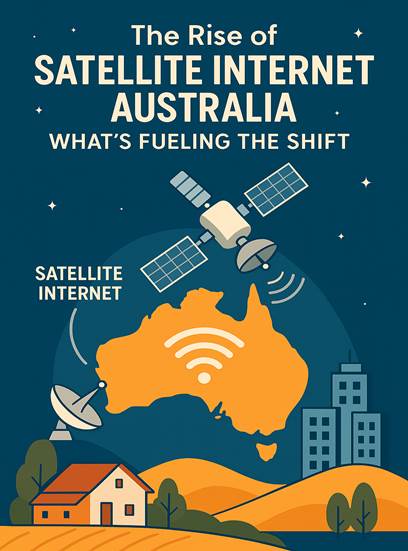
- What is Satellite Internet?
Satellite Internet links households through satellites circling the Earth, rather than relying on underground cables. Your data is sent from a dish at your property up to a satellite in space, relayed to a ground station, and then carried across the web. This process was created to tackle rural coverage challenges, extending access to areas beyond the reach of fixed wireless or fiber.
Quick Comparison: Different Internet Types in Rural Areas
| Connection Type | Typical Download Speed | Latency | Coverage | Ideal For |
| Satellite | 25–150 Mbps | 20–50ms | National | Remote, rural homes |
| Fixed Wireless | 25–100 Mbps | 20–50ms | Regional towns | Edge of metro areas, rural towns |
| NBN Fibre | 50–1000 Mbps | 5–20ms | Limited in rural regions (select towns) | Urban, suburban homes, and some regional towns |
Key Takeaway: -
Satellite Internet Australia is recognized for its overall coverage, though not always for speed or latency.
Key Advantages of Satellite Internet Australia
Why should you opt for satellite internet in Australia? Below are the top reasons –
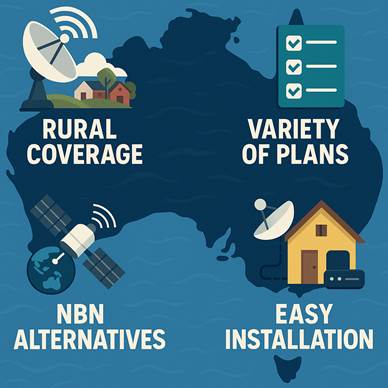
- Rural Coverage Beyond the Conventional Reach
- Provides internet access to remote outback, islands, and farming communities.
- Supports online learning, digital healthcare, and essential online services.
- Works without counting on phone lines or underground cables.
- An Expanding Variety of Satellite Plans
- NBN Sky Muster and independent providers now deliver tiered plans.
- Options include basic, standard, or advanced performance levels.
- Flexible data bundles match changing and fluctuating usage needs.
- Real NBN Alternatives for Remote Users
- In many cases, Satellite Internet Australia becomes the most viable NBN Alternative to stay connected.
- Can serve as a replacement whenBroadband Options such as ADSL, cable, or 5G are unavailable.
- Easy Installation
- Most setups involve only a very small dish and modem.
- No need to excavate property—installation often completed within some hours.
Expert Take
“Satellite connectivity has greatly improved life for remote and First Nations communities. With NBN Sky Muster, online learning and telehealth now reach a broader population than ever before.” – Dr. Kirsty Baines, Rural Telecommunications Council
Drawbacks of Satellite Internet Australia
Satellite Internet Australia experiences limitations rooted in physics—signals travel thousands of kilometers to space and back, leading to unavoidable latency.
1. More Sluggish Internet Connection Speed and Higher Latency
- Even on top satellite plans, actual speeds might fall short of advertised at the peak hours.
- Latency (a bit of delay in data travel) can make gaming, video calls, or real-time cloud work seem laggy.
2. Data Limits and Peak-Time Slowdowns
- There are some satellite plans that impose data caps or throttle speeds during packed hours.
- “Fair use” policies can mean slower internet especially if you consume large amounts of data.
3. Weather Disruptions
- Heavy storms or rain might temporarily affect your connection.
- More of a concern in cyclone-prone or tropical regions.
4. Price vs. Performance
- Monthly charges for satellite internet Australia could be slightly higher than for metro broadband options with better speeds.
- Equipment charges and installation costs can pile up quickly for new users.
A Quick Chart: Typical Satellite Plan Tiers and Everything You Get
| Plan Tier | Typical Download/Upload | Data Cap | Estimated Monthly Cost (AUD) |
| Basic | 25/5 Mbps | 50 GB | $40–$55 |
| Standard | 25/5 Mbps | 100–200 GB | $60–$80 |
| Premium | 50/10 Mbps | 200–300 GB | $90–$120 |
Important Note – Prices differ by zone, provider, and hardware.
How Does Satellite Stack Up to Other Broadband Options?
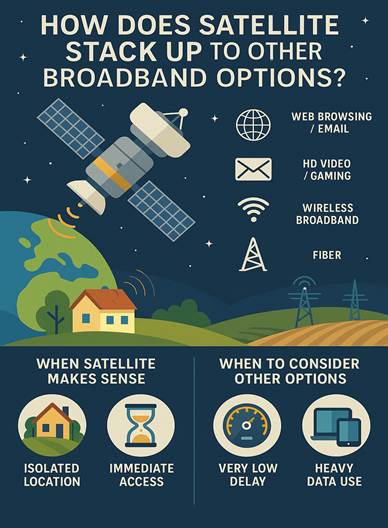
- Satellite Internet Australia is not only meant for the “deep bush” – it’s rather for beyond the coverage of fixed-line services.
- If you’re weighing up NBN alternatives, take your main online activities into consideration –
- Web browsing and email? Satellite performs really well.
- Watching HD video or online gaming? Wireless broadband or fiber (wherever available) may be a stronger fit.
- When Is Satellite Internet Make the Most Sense?
- You live on an isolated property with no other wired or mobile services.
- You want internet access immediately without waiting years for network rollouts.
- You require rural coverage for work, study, or online healthcare.
- When Should You Consider Other NBN Alternatives?
- You require very low delay for professional gaming, financial trading, or real-time cloud work.
- Your home has heavy, everyday data needs (multiple 4K streams, large downloads, etc.).
- You’re located where stronger broadband options or higher internet speed are available.
FAQs About Satellite Internet Australia
- What is the best thing about Satellite Internet Australia?
Satellite Internet Australia gives you reliable connection in rural and distant areas, no matter how far away you are from towns or cities.
- Are satellite plans more expensive than other NBN options?
Satellite plans might cost more per GB than metro NBN, but they are frequently the most optimum value for rural coverage.
- Can I switch to other broadband options later?
Yes, you can update and use your satellite arrangement as a backup if new broadband options or fiber become available.
Wrapping Up: Is Satellite Internet Australia Right for You?
Satellite Internet Australia perfectly closes the digital gaps for thousands of farms, families, and remote businesses. With unmatched rural coverage, easy installation, and better satellite plans emerging every year, it’s now become a lifeline for those beyond city cables.
Yet drawbacks such as higher latency, cost, and lower speeds mean it isn’t always the first choice where other NBN alternatives are available.
The Key Takeaway: For Australians who value staying connected more than sheer speed, satellite plans and NBN alternatives come up with a solid and improving solution. So, explore your options today, and pick a plan that best suits your need!
