
Community energy supportin Australia is gaining momentum, reaching as many as 1 in 3 at-risk households in New South Wales. While national programs remain steady and consistent, grassroots initiatives, including community housing solar projects and not-for-profit energy relief, are demonstrating real impact by delivering emergency aid, appliance upgrades, and energy coaching where it’s needed most.
These initiatives go beyond just quick fixes. Backed by non-profit energy help groups as well as churches, they offer charity electricity aid to households in crisis – providing tangible relief when bills grow unmanageable.
Consider this blog as your guideline through Australia’s community-driven energy support. Let's begin with what these programs actually are.
A Quick Summary
Community energy supportprograms are redefining how Australians manage high power expenses. Read this blog to discover how non-profit energy, charity electricity aid, and different local initiatives can help, and are making a huge difference. Also, you will learn how to access these useful resources, what kind of assistance they offer, and why they’re important in today’s energy landscape.
What Is Community Energy Support? Who Provides It?
Are you struggling to pay your bill? You’re definitely not alone! However, “help” might be closer than you imagine! In Australia, locally-led energy programs are stepping up where conventional measures may fall short.
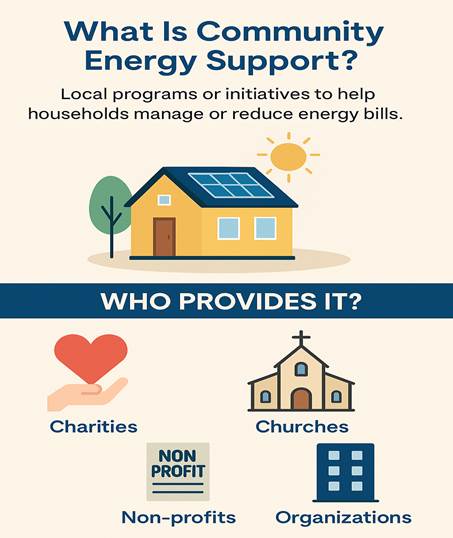
- Community Energy Support Explained
To put it simply, community energy support is local initiatives or programs – often run by churches, charities or non-profit organizations – that help Aussie households manage or slash energy bills.
Unlike government-funded rebates, such programs are typically –
- Grant-supported or donation-funded
- Intended for people dealing with immediate hardship
- Operated by local support workers or volunteers
Some of the most eminent providers in Australia include –
- Anglicare
- The Salvation Army
- St Vincent de Paul Society
- UnitingCare
- Australian Red Cross
These programs can offer short-term relief; household upgrades, or even effective payment plans for energy efficiency.
Expert Take –
"Community energy programs go beyond offering assistance – they uphold dignity by enabling households to take charge of their power usage,” says Lisa Hart, Energy Justice Coordinator at Sydney’s Power Assist Network.
Kinds of Non-Profit Energy Help Available in Australia
Not every assistance is the same. Here are some of the most result-yielding non-profit energy helpoptions available in the market.
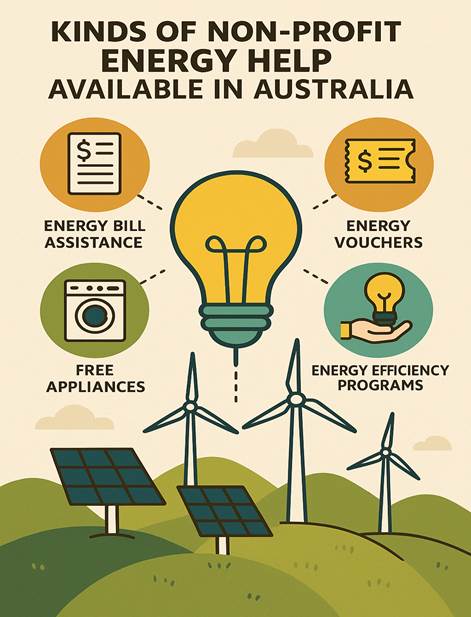
| Type of Program | What It Offers | Example Providers |
| Emergency Bill Assistance | Immediate payments to avoid disconnection | Salvation Army, Vinnies, Anglicare |
| Budgeting & Energy Education | Coaching to bring down usage and prevent future debt | UnitingCare, Brotherhood of St. Laurence |
| Home Energy Audits | Low-cost or Free inspections to find savings at home | Local Councils, Energy Neighborhoods |
| Appliance Upgrade Grants | Free replacement of old, inefficient appliances | State energy programs, NGOs |
| Energy Advocacy | Support with negotiations or complaints with retailers | Consumer Action Law Centre |
Every service has its unique eligibility criteria. Hence, it’s crucial to directly contact providers or check out their websites.
Who Is Eligible for Charity Electricity Aid?
If you've ever had to make a choice between groceries and paying your bill, you might already get eligibility. Charity electricity aid is tailored to support people in crisis situation – not only those on Centrelink. These programs lay emphasis on immediate requirements and customized, compassionate relief.
- So, Are You Eligible?
Almost every charity electricity aid is intended for Australians who –
- Are struggling with financial hardship (such as illness, job loss, unexpected bills)
- Hold concession cards (Health Care Card, Pensioner Concession)
- Facing possible disconnection or already disconnected
There are some programs that also consider the following –
- Family composition and size
- Remote or regional location
- Whether you're renting or a house owner
Here’s a quick summary of the typical eligibility markers –
| Requirement | Applies To |
| Concession card holder | Yes |
| Disconnection notice received | Yes |
| Proof of low income | Usually required |
| Pensioner or carer | Often prioritized |
Steps to Access Community Energy Support Programs
Accessing community energy support is more straightforward than it seems – and you won’t have to navigate it alone! Numerous community centers and charity organizations are ready to walk you through the process – one step at a time.
- Your Action Plan: Get the Help You Deserve
- Gather Documentation
- Recent energy bills
- Concession or pension cards
- Any disconnection notices
- Find a Program
- Explore official websites like Energy.gov.au
- Reach out to local charities, or community centers
- Book an Appointment or Apply Online
- Some programs may involve face-to-face interviews
- Others support online or phone-based applications
- Wait for Assessment
- This process typically spans 2 days to 2 weeks
- Urgent applications are often prioritized
- Receive Assistance
- Direct vouchers, bill payments or negotiated payment plans
For a useful and more insightful guide to government assistance, look into this – “A Guide to Energy Rebates for Pensioners & Low-Income Australians.”
Do Community Programs Work Complement Government Rebates?
- Complementary, Not Competitive
Yes, of course! The community energy support frequently operates alongside state-or national-funded rebates. In fact, many charities help you access both.
For example –
- You can access Energy Accounts Payment Assistance (EAPA) via St. Vincent de Paul alongside your Pensioner Concession rebate.
- Non-profit energy help teams commonly assist with paperwork, lodging complaints, and navigating complex support schemes.
Stat Insight – A 2024 study by Energy Consumers Australia revealed that around 68% of Australians accessing charity electricity assistance were also entitled to state concessions – but were unaware of the application procedure.
This is the reason why the combination of community energy supportand government rebates is so effective – it fills the access and knowledge gaps.
Why These Programs Matter Now More Than Ever
- Rising Costs = Expanding Community Need
Amid ongoing inflation and rising energy usage, energy poverty is escalating rapidly. Community energy support is no longer optional – it’s a necessity.
- Reasons why these programs matter –
- Minimize chances of disconnection during extreme heat or cold
- Provide mental and financial support to struggling families
- Foster long-term awareness and efficiency in power usage
- Encourage fair access to essential utilities
And perhaps most significantly – they preserve dignity.
FAQ About Community Energy Support
1.Can I apply for more than one support program at a time?
Yes. Many programs allow you to combine charity electricity aid with state or federal rebates.
2. What if I don’t have a concession card?
You may still be eligible if you’re facing short-term hardship. Always check with the provider.
3. Are these programs available in rural areas?
Absolutely. Regional programs exist—especially via church-based charities and local councils.
Begin Your Journey Toward Energy Relief
The community energy support ecosystem of Australia is responsive, robust, and ready to help. From non-profit energy help to ongoing charity electricity aidand emergencies, you have more options than you may imagine!
Being proactive is paramount. Start by reaching out to a local charity or counting on federal resources. You need not navigate energy hardship alone – as community means support.
