
When it comes to fast internet in Australia, the question is simple: NBN vs. cable broadband – who wins your digital race? If the jargon feels overwhelming, don’t worry, because many people feel that way.
Choosing the right internet type and best cable speeds is critical for everything from working remotely to binge-watching the latest shows in glorious 4K. It’s an investment in your daily life.
By reading this blog, you'll have the key to getting the fastest, most reliable data plans for your home or business.
Here’s a Quick Summary
Choosing between NBN vs. cable broadband in Australia comes down to technology, speed, and availability. The National Broadband Networkoffers flexible internet type, various speed tiers, and reliable unlimited data plans. Older cable networks once delivered strong cable speeds but are now being upgraded into the NBN’s Hybrid Fiber Coaxial (HFC) system. It makes the NBN network the go-to option for fast, stable internet across Australia.
How Do NBN vs. Cable Broadband Differ Technologically?
The fundamental disparity between each internet type lies in the physical infrastructure delivering the service to your premises.
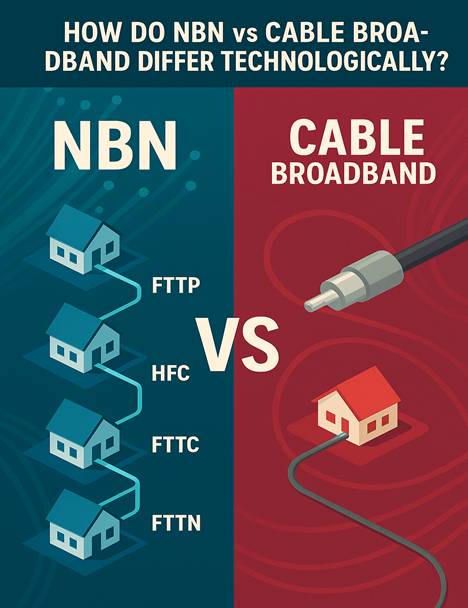
The National Broadband Network is Australia’s government-owned wholesale broadband access network. Its goal is to replace the old copper and cable networks with a mix of advanced technologies, which is known as the Multi-Technology Mix (MTM).
When it comes to NBN vs. cable broadband, the NBN represents the next-generation solution for faster and more reliable connectivity.
- Fiber to the Premises (FTTP): This is the gold standard. A fiber optic cable runs directly into your home. It delivers the fastest speeds and is the most reliable internet type.
- Hybrid Fiber Coaxial (HFC): Australia’s internet backbone uses the former pay-tv coaxial cables (Optus and Telstra's old cable networks) for the 'last mile' internet.
- Fiber to the Curb (FTTC): Fiber runs close to your premises, and the final internet connection uses the existing copper phone line. It generally offers strong performance.
- Fiber to the Node (FTTN): Fiber runs to a local street cabinet (the node), and the old copper wire handles the web connection from the node to your home. This is often the slowest and most unreliable fiber-based technology due to the distance over copper.
- Real-World Performance: What Do Aussies Experience?
The National Broadband Network delivers faster, more consistent speeds than legacy cable, especially at peak times. According to the ACCC’s Measuring Broadband Australia report (2024), NBN FTTP and HFC users typically get over 95% of their advertised speeds in the busy evening hours, while old cable users often see their speeds drop by 30% or more at night due to congestion.
NBN plans also offer better upload speeds and lower latency, making video calls, cloud backups, and online gaming smoother – huge for remote work and modern households. For many Australians, making a switch to the NBN means more stable and reliable internet all day.
How Do Cable Speeds Compare to NBN Speed Tiers?
When it comes to raw performance, a direct comparison requires looking at specific speed tiers. In the past, legacy cable broadband offered some of the fastest residential speeds in the country, often comfortably beating early ADSL and some lower-tier connections.
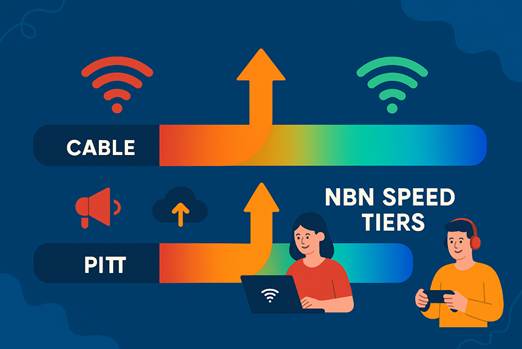
But there is more to internet performance than the numbers alone, and that's where the National Broadband Networkreally changes the game –
- Consistent Speeds Count: Old cable shared its bandwidth with everyone in the neighborhood, so while you might hit high speeds in the morning, come evening, when everyone's streaming Netflix or gaming, things could slow to a crawl.
- Pick a plan that fits you: NBN has given you clear-cut menu options from a basic 12 Mbps for browsing and emails to a full 1000 Mbps for heavy streaming and gaming.
- Uploads That Actually Work: With cable broadband, downloads were great, but uploads were poor. If you wanted to back up files to the cloud or join a video call without lag, forget it. The national broadband networkbalances download and upload speeds, which is perfect for working from home or sharing large files.
- Less Congestion, More Stability: Smart network management makes connections even more reliable. With FTTP and HFCtechnology, there is less dropout, smoother streams, and less frustration all around.
NBN Speed Tiers vs. Legacy Cable Performance
The National Broadband Network operates on a tiered system, which gives consumers flexibility but also complexity.
| NBN Speed Tier Name | Typical Download Speed (Mbps) | Internet Types Supported | Legacy Cable Speeds Comparison | Availability |
| NBN 12 (Standard) | 12 | All MTM types | Generally lower than max Cable | National |
| NBN 50 (Standard Plus) | 50 | All MTM types | Comparable to older, slower Cable | National |
| NBN 100 (Fast) | 100 | FTTP, HFC, FTTN/C (location dependent) | Similar to typical max cable speeds | Limited/Metro |
| NBN 250 (Superfast) | 250 | FTTP, HFC | Faster than legacy Cable | Growing |
| NBN 1000 (Ultrafast) | 500-900+ | FTTP, HFC | Much faster than Cable | Growing |
Expert Take: National Broadband Network pricing is considered competitive, with numerous RSPs offering plans. Theoretically, this competition pushes prices down, especially in the mid-range speed tiers (50 Mbps). So, the NBN's wholesale service providers need to compete with features, pricing, and support.
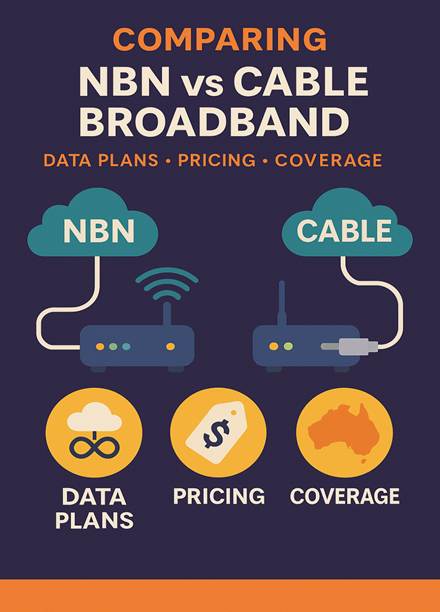
Comparing NBN vs Cable Broadband: Differences in Data Plans, Pricing, & Coverage
The National Broadband Network is a single national network. It makes it easier to compare availability, plan structures, and costs.
The Evolution of Data Plans and Pricing
For many Australians, the debate is now moot. It is because the legacy cable broadband networks, many of which were run by Telstra and Optus, have been largely decommissioned. It is rolled into the National Broadband Network's HFC footprint.
Coverage: The National Broadband Network aims to cover virtually every home and business in Australia, including those in regional and remote areas via fixed wireless and satellite. Legacy cable broadband was only available within limited metro areas, essentially in Sydney, Melbourne, Brisbane, and a few others.
- Data Plans: Both old cable and modern broadband plans offer unlimited data plans. With the increasing popularity of the National Broadband Network, unlimited data has now become a basic standard on most plans, providing users with more freedom online. You can easily switch or level up your data plans to match your household’s needs without worrying about running out each month.
- Pricing: National Broadband Network pricing is considered competitive, with numerous RSPs offering plans. Theoretically, this competition pushes prices down, especially in the mid-range speed tiers (50 Mbps). So, the National Broadband Network’s wholesale service providers need to compete with features, pricing, and support.
Modern Data Plans, Pricing, and Flexibility
NBN plans are now more affordable and flexible than cable ever was. Unlimited data is standard, with basic NBN plans starting around $49/month and high-speed options (like NBN 1000) reaching $130/month or more. In the old cable era, strict data caps and higher prices were common.
The NBN rollout has increased competition – dozens of providers now compete on price, speed, and support. No-lock-in contracts mean Australians can switch plans or providers easily for better value or faster speeds.
For most Aussies, the move means more choice, lower costs, and unlimited data to match modern internet needs.
FAQs for Australians: NBN Migration
1. Is cable broadband still available in Australia?
Not anymore; the old legacy cable networks that Telstra and Optus operated have been taken out of service. Their infrastructure coaxial cable now forms part of the National Broadband Network Hybrid Fiber Coaxial, or HFC component. You need to take a National Broadband Network plan.
2. How do I know if my internet type is an NBN HFC connection?
If your premises was previously served by cable TV and you were migrated to the National Broadband Network, you are probably on HFC. You can check your address on a provider's website. HFC requires a dedicated connection box (NTD) inside your home.
3. Can I get faster cable speeds now that I'm on NBN HFC?
Yes! Since September 2025, HFC has been available at much faster speeds: the National Broadband Network250 (Superfast) and National Broadband Network 1000 (Ultrafast) tiers offer performance that's significantly better than the old maximum cable speeds.
4. Do I need a new modem when changing from cable to NBN HFC?
Yes, you'll need an NBN-compatible modem-router. The same coaxial cables are used for the NBN Connection Box (NTD). Most providers will provide a suitable modem upon signing up.
5. Is NBN HFC more reliable than old cable broadband?
Generally, yes. The National Broadband Networkis actively maintaining and upgrading HFC infrastructure. There are fewer dropouts and greater stability compared to the legacy cable systems. However, performance will still vary depending on network congestion in your area.
In a Nutshell
The debate regarding NBN vs cable broadband has indeed been settled in Australia. The National Broadband Network is now the single, national digital platform. The older cable broadband is actually just one of the technologies now used within the broadband framework, specifically the HFC type.
You can take advantage of the former cable broadband infrastructure for amazing high-speed data plans with an HFC connection, thanks to the huge speed upgrades rolled out in late 2025.
Always check your specific address to confirm your connection type and go with a provider who delivers consistent, fast performance.
