
It might seem like a coin toss while choosing between fixed and variable home loans. But what if you could have both at once? That's exactly what a split home loan offers: a savvy blend of certainty and flexibility.
An increasing number of Australians are making use of part fixed part variable or hybrid home loan benefits as a means of balancing security with savings. It's the clever middle ground between locking in a steady rate and staying open to market opportunities.
So, if you want to know how a split rate home loan can benefit you, you’re at the right place.
A split home loan splits your mortgage into two halves – one fixed, the other variable. In this blog, we have explained the hybrid home loan benefits and when to choose this structure. Insimple terms, you will understand how the split home loan and the part-fixed part-variable loan terms work. It will help you manage your rate risk while maximizing flexibility.
What Is a Split Home Loan? Let’s Find Out
In a split home loan, your mortgage is divided into two portions:
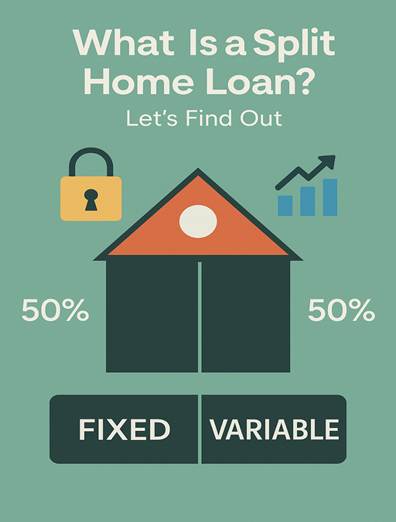
- Fixed portion: a locked rate for a chosen term, usually ranging from 1–5 years.
- Variable portion: This changes with market trends. It also gives flexibility.
Suppose you borrow A$ 93,295.4 AUD. You could choose to fix A$ 46,647.70 AUD of your loan at 7% interest while keeping the remaining A$ 46,647.70 AUD variable at 6.75% interest. And the outcome? Half your loan stays steady, while the other half benefits if the rates go down.
Why Choose a Split Home Loan?
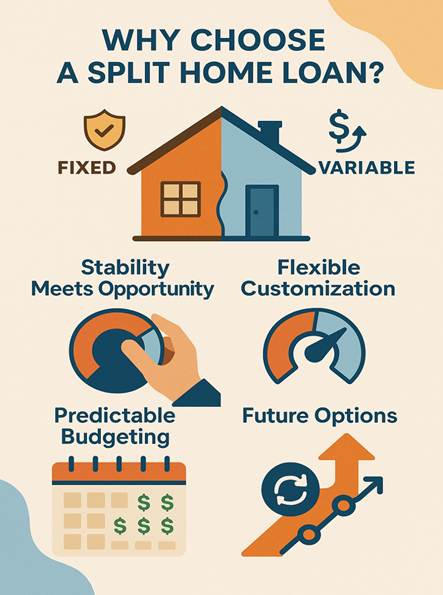
1. Stability Meets Opportunity
Your fixed side shields you from rising rates. The variable side lets you benefit when rates fall.
2. Flexible Customization
It’s your decision how much to fix and how much to keep flexible. You adjust it to your comfort level and market view.
3. Predictable Budgeting
Part of your repayments remains fixed. Those are, therefore, easier to plan for. The rest remains flexible.
4. Future Options
Remember, you can always refinance home loan terms later. You can rebalance your split as your needs change.
Split vs Fixed vs Variable – A Quick Comparison
| Feature | Fixed Loan | Variable Loan | Split Home Loan (Hybrid) |
| Interest Rate | Static | Dynamic | Part fixed part variable |
| Repayment Stability | High | Moderate | Balanced |
| Flexibility | Low | High | Medium–High |
| Savings Potential | Limited | High (if rates fall) | Moderate–High |
| Risk Level | Low | High | Medium |
| Best For | Budget-conscious borrowers | Those who can take a risk | Balanced thinkers |
Expert Take: “The best advantage of a split home loan is the flexibility to structure your loan to suit your financial needs.” – Julian Finch, Founder of Finch Financial Services.
How Much Should You Split?
This depends on your goals, how stable your income is, and your view of the market.
- Risk Comfort:
- Prefer predictability? Fix around 70%.
- Comfortable with fluctuation? Keep 70% variable.
- Market Forecast:
- Expecting rate hikes? Fix more.
- Anticipating drops? Keep more variables.
- Loan Duration:
- A smaller loan means a higher variable for savings.
- A longer loan means a larger fixed share for stability.
- Future Changes:
- Planning on selling or upgrading anytime soon? A variable share offers easier exits.
Expert Quote – According to data from Mozo, approximately 3.3 million owner‑occupied homes in Australia had a mortgage as of March 2025, underscoring the scale of the market in which a split home loan may provide advantage.
What Things to Keep in Mind Before Committing?
Always compare home loans from several providers before deciding on a split home loan. Look for:
- Interest rate differences
- Re-draw or offset features
- Switching flexibility
Even a small 0.2% rate gap can amount to big savings over time.
Pro Tip: Use online loan comparison tools to observe how different splits impact your total repayment.
When Does a Split Home Loan Make Sense?
It is suitable for borrowers who:
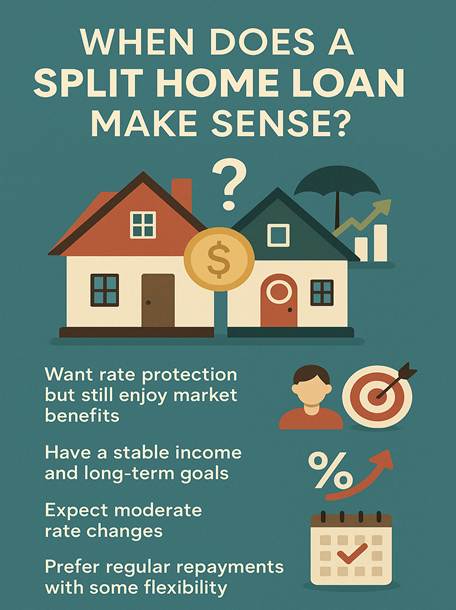
- Want rate protection but still enjoy market benefits.
- Have a stable income and long-term goals.
- Expect moderate rate changes.
- Prefer regular repayments with some flexibility.
In other words, if you want both control and opportunity, then this hybrid home loan model is your sweet spot.
Why a Split Home Loan Offers the Best of Both Worlds
- A split home loan balances fixed stability with variable flexibility.
- It provides the hybrid home loan benefits of predictability and potential savings.
- Ideal for those who seek both peace of mind and profit potential.
- Ratios are flexible; thus, you may adjust the structure to suit your needs.
- Although terms can always be refinanced for a home loan later, in case the situation changes.
FAQs
1. What is a Split Home Loan?
A split home loan consists of a fixed interest rate and a variable interest rate. This helps you to know exactly how much you have to pay for the fixed part. Thus, it makes your payments more stable and protects you from big ups and downs in the market.
2. What are the main advantages of this hybrid structure?
The main benefits of hybrid home loans include predictable budgeting, protection from rate rises, and flexibility to capitalize on lower rates. It's also customizable; you can choose the ratio that best suits your lifestyle and risk tolerance.
3. Can I change my split ratio later?
Yes, most lenders will let you change how your loan is split between fixed and variable rates. After getting a new loan term, you can move money between the fixed and variable parts.
4. Is a split loan the right choice for me?
For those who value both stability and flexibility, a split home loan is worth considering. It's perfect for first-time buyers, families, or anyone planning long-term home ownership who doesn't want to bet entirely on one rate type.
The Final Words
A split home loan can keep you steady without missing out when interest rates unexpectedly swing in the market. This is not about taking sides; this is about balance. It gives you a long-term ownership.
Before you lock in your next loan, take a moment to make a comparison between home loans. Also consider your risk comfort and build a strategy that works for you. Being financially smart today isn't about guessing the market. It's preparing for both outcomes with a part-fixed-part-variable approach.
