
Self-employed or have a small business—and struggling to get a home loan without tax returns or payslips? Neither are you alone nor out of suitable options. Conventional home loans generally favor 9-to-5 employees with tax returns and neat payslips.
However, for gig workers, freelancers, and budding business owners, the paperwork doesn’t fit the mold. This is where low doc home loans come into play! It’s designed for modern Australian borrowers who count on self-employed income docs or require a no payslip home loan to turn their property visions into a reality.
A Quick Summary
A low doc home loan refers to a mortgage option that allows non-traditional or self-employed earners to use alternative income documents to qualify for a loan. This guideline sheds light on how these loans work in Australia, who actually qualifies, and the key factors to consider helping you determine if this solution is flexible and suits your financial situation.
What Are Low Doc Home Loans?
Low doc home loansare the abbreviation for “low documentation home loans.” It is tailored for borrowers who cannot offer standard financial paperwork such as group certificates or regular payslips. This type of loan garnered popularity in Australia to help freelancers, budding business owners, and self-employed individuals access property finance.
- Some of the Key Features
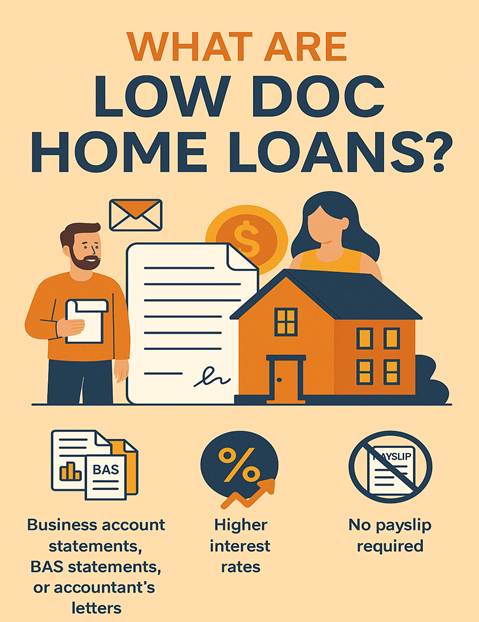
- You can apply with alternative paperwork like business account statements, BAS statements, or accountant’s letters. These are referred to as self-employed incomedocs.
- Interest rates for low doc home loans could be a bit higher than the standard mortgages.
- There are some banks that provide a no payslip home loan for those with irregular income streams.
Why is this so important?
If you don’t have a traditional career, this loan can help you make the purchase of a home.
How Do Low Doc Home Loans Work?
The process for low doc home loans shares similarity to standard loans, but the documentation is different.
- Necessary Documents
Instead of payslips, you might require the followings –
- BAS (Business Activity Statements)
- Business bank statements (typically 6–12 months)
- Accountant’s letter or declaration
- ABN registration proof
- GST registration proof
Quick Table: Standard Loan vs. Low Doc Loan Documentation
| Criteria | Standard Home Loan | Low Doc Home Loan |
| Payslips | Required | Not Required |
| Tax Returns | Required (2 years) | Sometimes Required |
| Self-Employed Income Docs | Not Needed | Required (BAS, accountant) |
| Minimum Deposit | 5–10% | 20%+ |
| Interest Rate | Standard | Slightly Higher |
| No Payslip Home Loan Option | No | Yes |
Who Qualifies for a Low Doc Home Loan? Let’s Find Out
Find out if you qualify for low doc home loans in Australia.
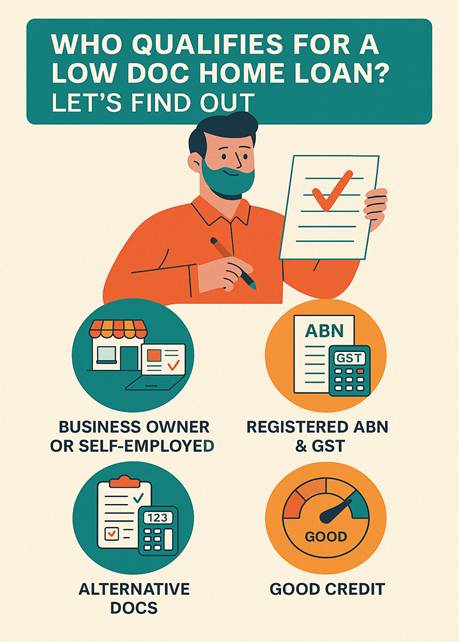
- Business Owner or Self-Employed: You should run your own business, work on freelance gigs, or earn non-traditional income.
- Registered ABN & GST: Most lenders need a minimum of 1–2 years of ABN (Australian Business Number) and often GST registration.
- Alternative Docs: You can share self-employed income docs such as business statements, BAS, or accountant letters.
- Larger Deposit: You must have the ability to pay around a 20% or larger deposit.
- Good Credit: A crystal-clear credit history is critical.
- Australian Residency: You should be an Australian citizen or at least a permanent resident.
Advantages and Drawbacks of Low Doc Home Loans
Advantages
- Flexible Documentation: Rely on self-employed income docs rather than counting on payslips.
- Home Ownership Opportunity: An ideal option for non-traditional earners.
- Fast Approval: Some lenders may also come up with fast turnaround for no payslip home loan applications.
Considerations
- Higher Interest Rates: Slightly pricier than regular loans.
- Bigger Deposit: At least 20% is needed.
- Fewer Lender Options: Not every bank provides this product.
- More Scrutiny: Lenders might carefully review your application thoroughly.
Expert Take: “Low doc home loans can help self-employed Australians, but borrowers must compare different options and understand every term,” says an MFAA-accredited broker.
When Should You Consider a Low Doc Home Loan?
Are you having trouble obtaining approval for a standard mortgage because of missing payslips or non-traditional income? If yes, then consider low doc home loans. These could be useful if you –
- Run a small business or own variable income.
- Want to buy property before two full years of tax returns are available.
- Seek a faster application process through self-employed income docs.
Low Doc Home Loans vs. The Other Options
Let’s now quickly find out how low doc home loans could be compared with standard mortgages and several other popular types of loan –
| Feature | Low Doc Home Loan | Standard Home Loan | First Home Buyer Loan | Investment Home Loans |
| Docs Needed | BAS, accountant | Payslips, tax | Payslips, tax | Payslips, tax |
| Deposit Required | 20%+ | 5–10% | 5–10% | 10–20% |
| Rates | Slightly Higher | Standard | Might Differ | Might Vary |
| Who Is Eligible | Self-Employed | Anyone | First-Time Buyers | Investors |
| Payslips Needed? | No | Yes | Yes | Yes |
How Should You Apply for a Low Doc Home Loan?
Are you prepared to proceed? Check out this step-by-step guideline –
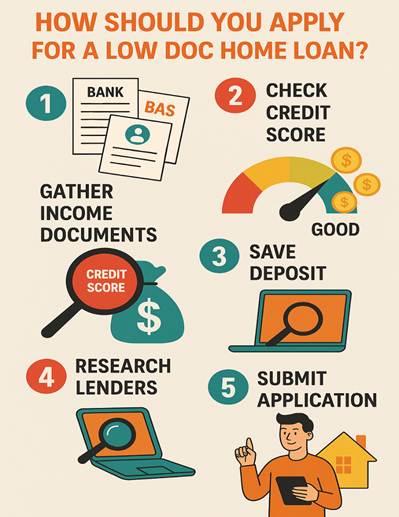
- Collect self-employed income documents like bank statements, BAS, accountant’s letter, etc.
- Consider checking your credit score and cleaning up any negative entries.
- Save for up to 20% deposit; this is kind of non-negotiable.
- Research lenders thoroughly! Not every lender provides low doc home loans.
- Apply online or through a trusted broker. Many brokers specialize in such loans.
FAQs on Low Doc Home Loans
1. What qualifies as self-employed income docs for a low doc home loan?
Lenders accept business bank statements, BAS statements, accountant’s letters, and ABN/GST registrations as self-employed income docs
2. Is a no payslip home loan meant only for self-employed people?
Most of the no-payslip home loans are meant for self-employed borrowers, but some lenders might consider commission-centric or contract workers too.
3. Can you get a low doc home loan with poor credit?
The importance of a decent credit history is paramount in low doc home loans.However, some lenders may consider applicants with past credit issues.
4. What should you seek while comparing low doc home loans?
Make sure that you compare home loans for fees, interest rates, necessary documents, and lender flexibility.
The Bottom Line
Low doc home loans provide both non-traditional earners and self-employed Australians with a real shot at property ownership, even if you lack any standard paperwork. With the flexible needs for self-employed income docs and options for a no payslip home loan, this mortgage type bridges a major gap in the market.
Just keep in mind – higher interest rates and deposits mean careful planning is important.
